
LEAD YOURSELF FIRST
Mind Your Success Weekly Newsletter: Executive Function and Presence

This week’s NeuroHumanity theme brings us back to the quiet work beneath visible growth: learning to be present for how life presents, without immediately judging, avoiding, controlling, or collapsing.
Mastering the inner game is not about becoming emotionally untouched. It is about learning how to stay connected to yourself when pressure rises, choices become unclear, and your nervous system wants to either over-function or disappear. This is where executive functioning becomes more than productivity. It becomes leadership presence in motion.
In NeuroHumanity, a diagnosis, struggle, or pattern is not the whole of who a person is. It is information. It is a doorway into awareness, nervous system capacity, relational dynamics, leadership, and purposeful living. Growth begins when we can look at what is happening inside us without turning that awareness into shame. NeuroHumanity describes this as understanding the patterns beneath behavior through the relationship between awareness, the nervous system, relationships, and leadership.
This week’s content invited us into that work.
Awareness
The theme of the week was executive functioning and leadership presence.
The core insight is simple, but not always easy to live:
You can be emotionally aware and still struggle to lead your life well.
You can understand your patterns and still abandon your priorities under pressure.
You can want growth deeply and still get pulled into urgency, avoidance, over-control, or reaction.
That is why executive functioning matters. It helps translate insight into movement. It is the inner capacity that allows you to pause, decide, prioritize, follow through, regulate, repair, and return.
This week also asked us to question what we call discipline.
Sometimes discipline is healthy devotion.
Sometimes it is the mole of the mind burrowing under the surface, creating tunnels of urgency, pressure, false productivity, and self-abandonment.
Not everything intense is leadership.
Not everything demanding is devotion.
Not every push forward is growth.
This is where the inner garden matters. It is important to know where you are in your inner garden and how you are using the three pillars, accountability, dedication, and purpose, to either pull you toward the surface or keep you pulled toward the tar pit of the mind. There is no wrong answer. The work is presence without judgment, letting life present. No one space predicts greater success or value. Awareness and presence are the determinants of capacity and value.
The week’s inputs, including the weekly challenge, article themes, Substack Live focus, and reader actions, all centered on helping readers move from awareness, to acceptance, to action through the NeuroHumanity lens.
Acceptance
If you have been struggling to execute, it does not automatically mean you are lazy, broken, undisciplined, or incapable.
Sometimes inconsistency is a capacity issue.
Sometimes procrastination is nervous system protection.
Sometimes overworking is not ambition, but activation.
Sometimes avoidance is not indifference, but overwhelm.
Sometimes self-attack gets mislabeled as accountability because it creates the illusion of control.
This is why shame is such a poor leader. Shame may create movement for a moment, but it rarely creates trust. And without internal trust, the nervous system stays braced. A braced system can perform, but it cannot deeply integrate.
From a NeuroHumanity perspective, growth does not happen because we force ourselves into a better version of ourselves. Growth happens as we learn to remain present long enough to notice the pattern, understand the need beneath it, and choose a response with more integrity.
NeuroHumanity’s Integrity Activation Framework describes the moment when awareness interrupts a survival reaction. When the brain perceives threat, it may pull past experiences into the present and prepare the body to react through defensiveness, withdrawal, people-pleasing, or emotional overwhelm. Integrity Activation invites a different approach: noticing the activation before it becomes the whole story.
That is leadership.
Not perfection.
Not constant calm.
Not never getting triggered.
Leadership is learning to return to presence before the reaction becomes the decision-maker.
Action: 3 Bite-Size Practices for This Week
1. Check the condition of your soil before asking for more output.
Before asking, “How can I get more done?” pause and ask, “What is the condition of my inner soil right now?”
Am I regulated enough to make a clear decision?
Am I pushing from devotion or pressure?
Am I leading myself, or am I reacting to urgency?
Try the 5-minute reset before you decide your next move.
2. Notice what is driving your decisions.
This week, choose one recurring decision point and study it without shame.
Do you say yes from purpose, fear, guilt, image management, avoidance, pressure, or clarity?
You do not have to judge the answer. Just notice the driver.
That awareness is the beginning of inner leadership.
Explore more through Mastering Your Inner Game.
3. Give yourself the time your humanity deserves.
Growth often begins beneath the surface before it becomes visible.
This week, practice honoring small signs of change:
A pause.
A quicker recovery.
A clearer no.
A steadier rhythm.
A moment where you responded instead of reacted.
These are not small. These are signals that integration is happening. Take the first step: Book a 15-minute Consultaiton: https://calendar.google.com/calendar/u/0/appointments/schedules/AcZssZ2oABJtsKc9185I6u-OFzYG1kO2-SbadZOnKsUN_er2TywkPV5kxcIHJ5d0ikqM5v5BRYxnJrY_
Weekly Highlights
Monday Weekly Challenge: Lead Yourself First
This week’s challenge focused on executive functioning as the operational side of inner leadership. Insight matters, but insight alone does not protect what matters under pressure. The invitation was to practice deciding clearly, following through steadily, and leading yourself before trying to lead the moment.
Read it here: Lead Yourself First: The Power of Executive Functioning
Tuesday Cultivating Mental Blooms: When the Mole of the Mind Calls It Discipline
Tuesday’s piece invited us to notice the difference between true discipline and activated urgency. Sometimes the mind burrows beneath the garden, creating pressure that looks productive but disconnects us from the condition of our inner soil.
Read it here: When the Mole of the Mind Calls It Discipline
Wednesday Integration Lab with Emma: Emotional Regulation Workshop
Wednesday brought emotional regulation into everyday leadership. Regulation is easiest to practice when life is calm, which is why we build the skill before pressure rises. The goal is not to eliminate stress, but to slowly increase the capacity to respond rather than emotionally react.
Watch or read here: Emotional Regulation Workshop
Thursday NeuroHumanity in Action: Give Yourself Three Years to Grow
Thursday reminded us that growth often follows the rhythm of “first they sleep, then they creep, then they leap.” The nervous system does not bloom on demand. Giving yourself time to grow can be an act of wisdom, not delay.
Read it here: Give Yourself Three Years to Grow
Friday Fives: 5 Signs You Are Growing Even If It Does Not Feel Like It
Friday’s piece named the quieter signs of growth: a pause, quicker recovery, more tolerance for uncertainty, and the growing mismatch between who you were conditioned to be and who you are becoming. Growth is often present long before it becomes obvious.
Read it here: 5 Signs You Are Growing Even If It Does Not Feel Like It
Tuesday 7 PM Substack Live: Accountability Without Shame
This week’s live focuses on accountability as the first pillar. We will explore the difference between accountability and self-attack, awareness and punishment, and staying present without collapsing. The goal is to strengthen capacity, not intensify shame.
Join here: Accountability Without Shame Live
NeuroHumanity Framework Piece of the Week: Integrity Under Activation
This week’s NeuroHumanity piece is Integrity Under Activation.
Integrity is easiest to talk about when we are calm. It is harder to practice when the body feels threatened, unseen, rushed, judged, or out of control.
Under activation, many people become reactionary instead of responsive. The nervous system scans for danger. The mind reaches for old explanations. The body prepares to defend, withdraw, please, fix, prove, or shut down.
Integrity under activation does not mean you never react.
It means you learn to notice the reaction before it leads.
It means you ask:
What is happening in me right now?
What story is my nervous system pulling into this moment?
What response would align with who I am becoming?
What part of this dynamic is mine to own?
This is the heart of inner leadership. The goal is not to shame the reaction. The goal is to create enough space for awareness to interrupt survival and allow a more conscious response to emerge.
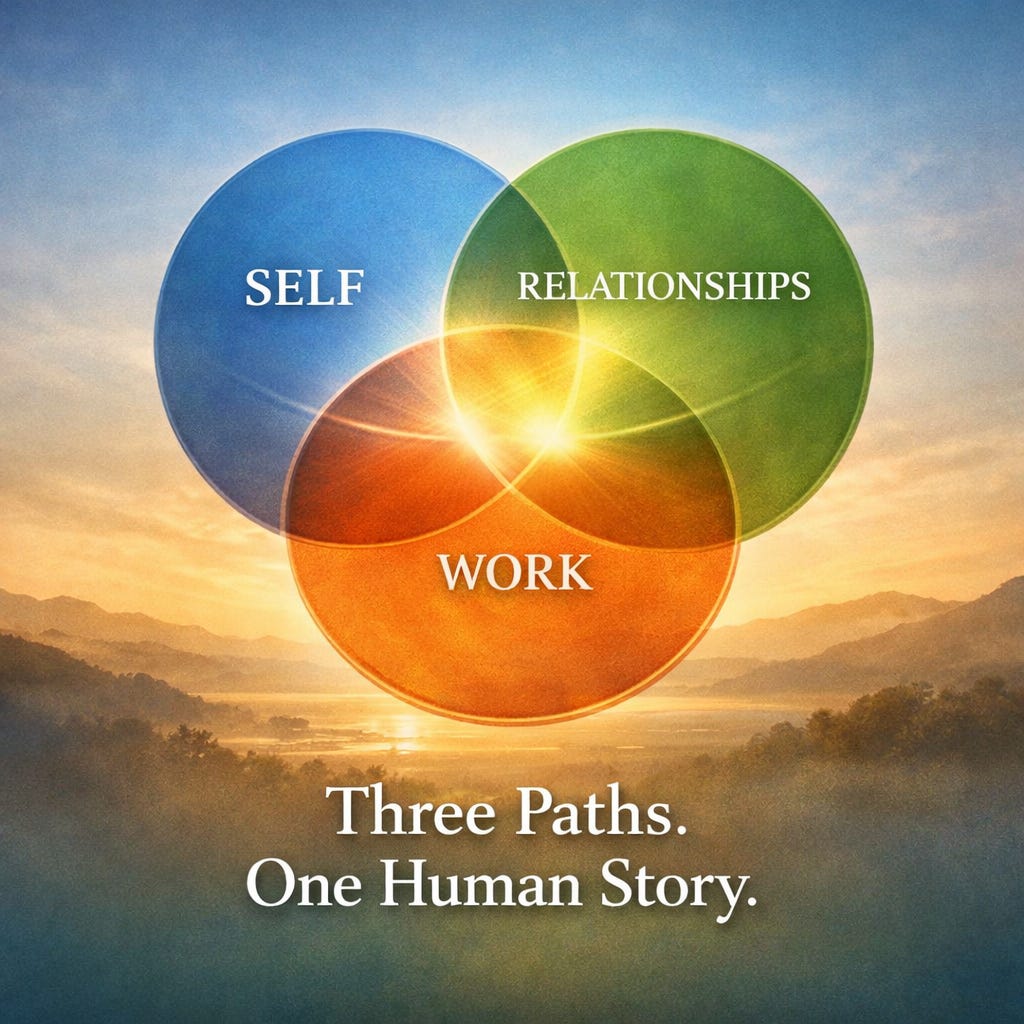
3 Paths, 1 Human Story
This week’s theme applies to self, relationships, and work because activation does not stay neatly contained in one part of life.
In the self, activation can look like procrastination, overthinking, self-attack, urgency, or avoidance.
In relationships, it can look like defensiveness, shutting down, blaming, explaining too much, people-pleasing, or trying to control the emotional climate.
At work, it can look like reactive leadership, poor follow-through, unclear priorities, emotional decision-making, or calling pressure “discipline.”
The shared invitation is ownership without shame.
When we learn to own our half of the dynamic, we stop making every problem about someone else and stop making every struggle proof that something is wrong with us. We begin to see the pattern, regulate the body, name the need, and choose the next aligned action.
Growth begins within. When you strengthen your inner world, every part of life has the chance to shift.
Wherever you begin, self, relationships, or work, you do not have to navigate growth alone.
Learn what your half of the dynamic is here: Take the Relationship Quiz
3 Key Takeaways From the Week
Executive functioning is not cold or rigid. It is leadership presence in motion. It helps you stop living by default and start living by design.
Growth is often present long before it becomes obvious.
Sometimes what we call discipline is self-sabotage dressed in executive language.
Start Here
Growth begins within. When you strengthen your inner world, every part of life has the chance to shift.
Choose your path forward:
Join the Free Self-Paced Masterclass
Book a Free 15-Minute Consultation
Ready to begin with support?
Integration Invitation
This week, do not rush past the lesson trying to become better overnight.
Slow down.
Notice where your inner garden is asking for attention.
Notice where accountability becomes self-attack.
Notice where discipline becomes pressure.
Notice where executive functioning could become an act of care instead of control.
Then choose one small place to lead yourself with presence.
Join me Tuesday at 7 PM for our Substack Live, Accountability Without Shame, as we continue the conversation around what lives beneath the soil and how to strengthen capacity without turning growth into punishment.
Thank you for all your support and joining us each week. Our goal is to meet you where you are in your change journey. Comment and share your takeaways and question. We love and value our community so much.
Your Empowering Wellness Team,
Jennifer Evans, LMHC, LPC and Emma VonHolten, MS